
07-llamaindex数据摄取管道
| 版本 | 内容 | 时间 |
|---|---|---|
| V1 | 新建 | 2026年04月20日17:29:01 |
概念定义
数据摄取管道 IngestionPipeline 是基于转换器(Transformation) 模式的流水线框架,每个转换器负责一个特定的数据处理任务,数据在管道中依次经过所有转换器,最终输出可直接用于构建索引的增强型节点。
它是 LlamaIndex 中端到端、可重复、可缓存、可增量、可扩展的数据处理核心组件,它将 "文档加载→文本分割→元数据提取→嵌入生成→索引构建" 等分散步骤整合为一个统一的流水线,彻底解决了传统 RAG 中数据处理代码混乱、难以维护、无法复用的问题。
原始文档 ──→ IngestionPipeline ──→ 带嵌入的 Node 列表 ──→ 存入向量数据库没有管道时,你需要手动写:
# 传统方式(繁琐、无缓存、无法增量)
docs = SimpleDirectoryReader("data/").load_data()
splitter = SentenceSplitter()
nodes = splitter.get_nodes_from_documents(docs)
embed_model = OpenAIEmbedding()
for node in nodes:
    node.embedding = embed_model.get_text_embedding(node.text)
vector_store.add(nodes)
有了管道后:
pipeline = IngestionPipeline(
    transformations=[
        SentenceSplitter(chunk_size=512),
        OpenAIEmbedding(),
    ],
    vector_store=vector_store,
)
nodes = pipeline.run(documents=docs)  # 一行搞定
在 RAG 全流程中的位置
数据源(文档/网页/API)
    ↓
[数据加载器(Reader)] → 生成Document对象
    ↓
[IngestionPipeline]  ← 本文核心
    ↓ 转换器依次执行
    1. 文档清洗
    2. 文本分割 → 生成Node对象
    3. 元数据提取 → 增强Node
    4. 嵌入生成 → 为Node添加向量
    ↓
[索引构建器(Index)] → 生成向量索引
    ↓
[查询引擎(QueryEngine)] → 提供问答能力
核心优势
- 模块化设计:所有处理步骤都是独立的转换器,可自由组合和替换
- 可复用性:同一管道可用于处理不同来源的文档
- 内置缓存:自动缓存转换结果,避免重复处理相同数据和重复调用 LLM / 嵌入模型
- 异步支持:原生支持异步处理,大幅提升批量处理速度
- 可观测性:支持进度条、回调函数和日志记录
- 持久化:可将管道状态和处理结果持久化到磁盘,支持断点续传
- 去重能力:集成 DocStore 自动检测和跳过重复文档
TransformComponent(转换器基类)
所有管道步骤的统一接口,定义在 llama_index/core/schema.py:
class TransformComponent(BaseComponent, DispatcherSpanMixin):
    @abstractmethod
    def __call__(self, nodes: Sequence[BaseNode], **kwargs) -> Sequence[BaseNode]:
        """接收 Node 列表,返回转换后的 Node 列表"""

    async def acall(self, nodes: Sequence[BaseNode], **kwargs) -> Sequence[BaseNode]:
return self.__call__(nodes, **kwargs)核心特征:
- 输入输出都是
Sequence[BaseNode],天然支持链式调用 - 继承
BaseComponent(Pydantic 模型),支持序列化/反序列化 DispatcherSpanMixin提供链路追踪(Langfuse 等可对接)
内置转换器分为四大类:
| 类型 | 含义 | 基类 | 作用 | 代表 |
|---|---|---|---|---|
| NodeParser | 节点解析器 | NodeParser(TransformComponent) | Document → Node(切分) | SentenceSplitter, CodeSplitter |
| Embedding | 嵌入生成器 | BaseEmbedding(TransformComponent) | Node → 带 embedding 的 Node | OpenAIEmbedding, OllamaEmbedding |
| Extractor | 元数据提取器 | BaseExtractor(TransformComponent) | 用 LLM 提取元数据 | SummaryExtractor, TitleExtractor |
| 自定义 | 自定义逻辑 | 直接继承 TransformComponent | 任意转换逻辑 | 过滤、重写、增强 |
内置转换器详解
NodeParser 类(文档切分)
from llama_index.core.node_parser import (
    SentenceSplitter,       # 按句子切分(最常用)
    TokenTextSplitter,      # 按 token 切分
    CodeSplitter,           # 按代码 AST 切分
    SentenceWindowNodeParser,  # 单句+窗口
    SemanticSplitterNodeParser,  # 语义相似度切分
    HierarchicalNodeParser,    # 多层级切分
    MarkdownNodeParser,     # 按 Markdown 标题切分
    HTMLNodeParser,         # 按 HTML 标签切分
)
在管道中的行为:接收 Document 列表,输出切分后的 Node 列表。
Embedding 类(向量化)
from llama_index.embeddings.openai import OpenAIEmbedding
from llama_index.embeddings.ollama import OllamaEmbedding
在管道中的行为:接收 Node 列表,批量调用嵌入模型,将结果赋值给 node.embedding,不改变 Node 数量和顺序。
Extractor 类(元数据提取)
from llama_index.core.extractors import (
    SummaryExtractor,
    TitleExtractor,
    KeywordExtractor,
    QuestionsAnsweredExtractor,
)
在管道中的行为:接收 Node 列表,用 LLM 为每个 Node 生成元数据并原地修改 node.metadata,返回相同 Node 列表。
IngestionPipeline 核心流程
属性
model_config = ConfigDict(arbitrary_types_allowed=True)
name: str = Field(
    default=DEFAULT_PIPELINE_NAME,
    description="Unique name of the ingestion pipeline",
)
project_name: str = Field(
    default=DEFAULT_PROJECT_NAME, description="Unique name of the project"
)

# 转换器链
transformations: List[TransformComponent] = Field(
    description="Transformations to apply to the data"
)

# 预加载的文档
documents: Optional[Sequence[Document]] = Field(description="Documents to ingest")
# 文档读取器配置
readers: Optional[List[ReaderConfig]] = Field(
    description="Reader to use to read the data"
)
# 向量存储
vector_store: Optional[BasePydanticVectorStore] = Field(
    description="Vector store to use to store the data"
)
# 转换缓存
cache: IngestionCache = Field(
    default_factory=IngestionCache,
    description="Cache to use to store the data",
)
# 文档存储(去重)
docstore: Optional[BaseDocumentStore] = Field(
    default=None,
    description="Document store to use for de-duping with a vector store.",
)
# 去重策略
docstore_strategy: DocstoreStrategy = Field(
    default=DocstoreStrategy.UPSERTS, description="Document de-dup strategy."
)
# 是否禁用缓存
disable_cache: bool = Field(default=False, description="Disable the cache")
不指定 transformations 时的默认值:
def _get_default_transformations(self):
    return [
        SentenceSplitter(),   # 默认按句子切分
        Settings.embed_model, # 使用全局默认嵌入模型
    ]
run() 方法执行流程
去重与增量更新
DocstoreStrategy
| 策略名称 | 核心逻辑 | 处理行为 | 适用场景 |
|---|---|---|---|
| UPSERTS | ID 存在性检查 | 若文档不存在则新增;若 ID 存在且内容变化则更新。 | 业务数据持续迭代,需要保留最新版本,不希望产生冗余副本。 |
| DUPLICATES_ONLY | Hash 重复性检查 | 仅当文档 Hash 已存在时才处理;完全新文档直接丢弃。 | 仅需过滤掉在流程中重复产生的垃圾数据,不关心历史全貌。 |
| UPSERTS_AND_DELETE | ID 存在性检查 + 全量同步 | 执行 UPSERTS 逻辑,同时删除本次流程未出现的旧文档。 | 对文档库存储空间敏感,需要严格保持文档库与当前输入数据的一致性,即 “只保留最新的”。 |
自定义转换器
方式一:直接继承 TransformComponent
class AdvancedTextCleaner(TransformComponent):
    """高级文本清洗器,去除多余空行、重复内容和敏感信息"""

    def __call__(self, nodes: List[BaseNode], **kwargs: Any) -> List[BaseNode]:
        for node in nodes:
            # 去除多余空行
            text = re.sub(r'\n\s*\n', '\n\n', node.text)
            # 去除邮箱地址
            text = re.sub(r'\b[A-Za-z0-9._%+-]+@[A-Za-z0-9.-]+\.[A-Z|a-z]{2,}\b', '[EMAIL]', text)
            # 去除电话号码
            text = re.sub(r'\b\d{3}[-.]?\d{3}[-.]?\d{4}\b', '[PHONE]', text)

            node.text = text

        return nodes
方式二:继承 BaseExtractor(LLM 提取元数据)
from llama_index.core.extractors import BaseExtractor
from llama_index.core.schema import BaseNode
from typing import Sequence, List, Dict, Any
from pydantic import Field

class SentimentExtractor(BaseExtractor):
    """用 LLM 分析每个 Node 的情感倾向"""
    llm: Any = Field(description="LLM to use")

    async def aextract(self, nodes: Sequence[BaseNode]) -> List[Dict]:
        results = []
        for node in nodes:
            response = await self.llm.acomplete(
                f"分析以下文本的情感倾向,只返回正面/中性/负面:\n{node.text[:200]}"
            )
            results.append({"sentiment": str(response).strip()})
        return results
方式三:继承 NodeParser(自定义切分逻辑)
from llama_index.core.node_parser import NodeParser
from llama_index.core.schema import BaseNode, TextNode
from typing import Sequence, List, Any

class FixedSizeNodeParser(NodeParser):
    """按固定字符数切分"""
    chunk_size: int = 500

    def _parse_nodes(self, nodes: Sequence[BaseNode], show_progress=False, **kwargs) -> List[BaseNode]:
        result = []
        for node in nodes:
            text = node.get_content()
            for i in range(0, len(text), self.chunk_size):
                chunk = text[i:i + self.chunk_size]
                result.append(TextNode(text=chunk, metadata=node.metadata.copy()))
        return result
数据摄取管道的使用
简单使用管道
llm = Ollama(model='qwen:0.5b')
embedded_model = OllamaEmbedding(model_name="qwen3-embedding:0.6b",
                                 embed_batch_size=50)
docs = SimpleDirectoryReader(input_files=["../../data/JavaInterview.txt"]).load_data()

# 构造一个数据摄取管道
pipeline = IngestionPipeline(
    transformations=[
        SentenceSplitter(chunk_size=200, chunk_overlap=0),
        TitleExtractor(llm=llm, show_progress=True)
    ]
)

# 运行这个数据摄取管道
nodes = pipeline.run(documents=docs)

print("len:", len(nodes))
for node in nodes:
    print("id:", node.node_id)
    print("metadata:", node.get_metadata_str(MetadataMode.ALL))
    print("content:", node.get_content())
    print("-"*100)
与索引构建集成
llm = Ollama(model='qwen:0.5b')
embedded_model = OllamaEmbedding(model_name="qwen3-embedding:0.6b",
                                 embed_batch_size=50)

docs = SimpleDirectoryReader(input_files=["../../data/JavaInterview.txt"]).load_data()

# 构造一个向量存储对象用于存储最后输出的Node对象
chroma = chromadb.PersistentClient(path="../../data/chroma_db")
collection = chroma.get_or_create_collection(name="pipeline")
vector_store = ChromaVectorStore(chroma_collection=collection)

pipeline = IngestionPipeline(
    transformations=[
        SentenceSplitter(chunk_size=100, chunk_overlap=10),
        TitleExtractor(llm=llm, show_progress=True),
        embedded_model  # 提供一个嵌入模型用于生成向量
    ],
    vector_store=vector_store  # 提供一个向量存储对象,用于存储最后的Node对象
)
_ = pipeline.run(documents=docs)

index = VectorStoreIndex.from_vector_store(embed_model=embedded_model, vector_store=vector_store)
query_engine = index.as_query_engine(llm=llm)


ret = query_engine.query("Java的垃圾回收器?")
# Response 对象不能直接 json.dumps,需要提取属性
print("回答:", ret.response)
print("来源节点数:", len(ret.source_nodes))
for i, src in enumerate(ret.source_nodes):
    print(f"  来源{i}: score={src.score:.4f}, text={src.node.get_content()[:100]}...")
输出
回答: Java的垃圾回收器是在运行时自动执行的一种清理算法。它会检查堆栈中的对象,并将那些不再使用的对象移除堆栈,从而实现垃圾回收的功能。
来源节点数: 2
  来源0: score=0.4295, text=答案:核心线程数、最大线程数、阻塞队列、拒绝策略、空闲线程存活时间。...
  来源1: score=0.4274, text=答案:核心线程数、最大线程数、阻塞队列、拒绝策略、空闲线程存活时间。...
高级特性
特性 1:缓存机制
IngestionPipeline 内置了强大的缓存机制,会为每个(输入节点 + 转换步骤)的组合计算哈希值,并将结果缓存起来。当再次运行管道处理相同数据时,会直接从缓存中读取结果,大幅节省时间和 API 调用成本。
from llama_index.core.ingestion import IngestionCache
from llama_index.storage.kvstore.redis import RedisKVStore

# 本地缓存(默认)
local_cache = IngestionCache()

# Redis缓存(适合分布式环境)
redis_cache = IngestionCache(
    cache=RedisKVStore.from_host_and_port(host="localhost", port=6379),
    collection="ingestion_cache"
)

# 创建带缓存的管道
pipeline = IngestionPipeline(
    transformations=transformations,
    cache=redis_cache
)
特性 2:文档去重
通过集成 DocStore,管道可以自动检测和跳过重复文档:
from llama_index.core.storage.docstore import SimpleDocumentStore

docstore = SimpleDocumentStore()

pipeline = IngestionPipeline(
    transformations=transformations,
    docstore=docstore,
    docstore_strategy="upserts"  # 只处理新增或更新的文档
)

# 第一次运行:处理所有文档
pipeline.run(documents=documents)

# 第二次运行:只处理新增或更新的文档
pipeline.run(documents=documents + new_documents)
例如:
第一次运行:  run(docs=[a.txt, b.txt])
  → DocStore 中无记录 → 全部处理
  → 存储: {a.txt: hash_abc, b.txt: hash_def}

第二次运行:  run(docs=[a.txt, b.txt])  ← 内容未变
  → a.txt 的 hash 匹配 → 跳过
  → b.txt 的 hash 匹配 → 跳过

第三次运行:  run(docs=[a.txt])  ← a.txt 内容修改了
  → a.txt 的 hash 不匹配 → 删除旧版本 → 重新处理 → 更新 hash
和 IngestionCache 的区别
| DocStore | IngestionCache | |
|---|---|---|
| 判断时机 | 转换前(决定是否处理) | 转换中(是否跳过某步计算) |
| 判断依据 | 文档内容 hash | 输入内容 + 转换器配置的 hash |
| 典型场景 | 增量更新:文件改了才重处理 | 避免重复的切分/嵌入计算 |
| 粒度 | 文档级 | 每个转换步骤级 |
可以理解为:DocStore 决定是否要跑,IngestionCache 决定跑了多少可以跳。
特性 3:异步处理
使用 arun 方法进行异步处理,大幅提升批量处理速度:
import asyncio

async def main():
    nodes = await pipeline.arun(documents=documents)
    print(f"异步处理完成,生成 {len(nodes)} 个节点")

asyncio.run(main())
特性 4:管道持久化
可以将管道状态(包括缓存和文档存储)持久化到磁盘,支持断点续传:
# 持久化管道
pipeline.persist("./pipeline_storage")

# 加载已保存的管道
loaded_pipeline = IngestionPipeline.load("./pipeline_storage")

# 继续处理
loaded_pipeline.run(documents=new_documents)
特性 5:并行处理
对于不依赖 LLM 的转换器(如文本分割、清洗),可以启用多线程并行处理:
pipeline = IngestionPipeline(
    transformations=transformations,
    num_workers=4  # 并发处理的worker数量
)
数据摄取管道架构总结
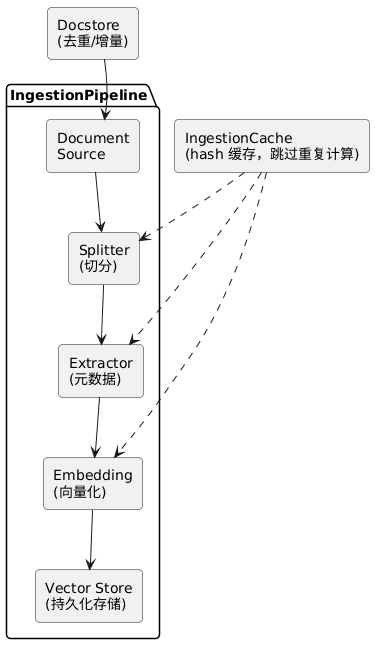
核心价值:
- 统一接口:所有转换器共享
TransformComponent接口,可自由组合 - 自动缓存:相同输入+相同转换器配置不会重复计算
- 增量更新:基于 docstore 的 hash 比较,只处理变化部分
- 端到端持久化:管道状态、缓存、向量库均可落盘,重启后恢复